Municipal treatment makes water safer to drink, but it does not remove hardness minerals. That is why homeowners in places like Indianapolis, Dallas, and Phoenix still battle scale on fixtures, cloudy glassware, and shortened appliance life. After evaluating the current field of residential softeners, the Best Water Softener For City Water is the SoftPro Elite for one simple reason: it is built around the actual chemistry and pressure conditions of municipal water, not a generic one-size-fits-all design.
A recent case that illustrates the point is the Morales family in Carmel, Indiana, on municipal water that averages about 14 GPG hardness based on local utility reporting and regional data. Elena Morales, 41, is a high school principal, and her husband David, 43, works in software implementation. They assumed “city water” meant their new dishwasher, tank water heater, and glass shower enclosure were protected. Within the first year, they were buying descaler, replacing faucet aerators, and wondering why towels felt stiff. Their first mistake was a magnetic descaler that changed none of the underlying hardness.
What follows is the framework I use when reviewing a municipal water softener: resin durability in chlorine or chloramine, regeneration efficiency, CCR-based sizing accuracy, flow performance under steady city pressure, and long-term ownership value. On those points, the SoftPro Elite consistently separates itself from conventional downflow units, big-box timer softeners, and salt-free conditioners.
Key Takeaways
- The SoftPro Elite uses chlorine-resistant 8% crosslink resin designed for continuous municipal disinfection exposure and a realistic 15–20 year resin life. Upflow regeneration is a major advantage on city water because it can cut salt use by up to 75% and water use by up to 64% versus standard downflow designs. Your city’s Consumer Confidence Report, or CCR, is the most useful free sizing tool; hardness listed in mg/L can be converted to GPG by dividing by 17.1. Most city water installations do not need a sediment pre-filter, which simplifies installation and lowers total system cost. Based on specifications, certifications, support structure, and long-term efficiency, SoftPro Elite is the strongest overall municipal water softener I reviewed.
QUICK ANSWER:
The SoftPro Elite Water Softener is my top pick for municipal water homes because it combines chlorine-resistant 8% crosslink resin, efficient upflow regeneration, and demand-initiated metering in a package designed for typical city supply conditions. It handles municipal hardness from 7 GPG to well above 30 GPG, delivers 15 GPM continuous flow with 18 GPM peak demand, carries NSF 372 certification and IAPMO materials safety approval, and comes in 32K, 48K, 64K, 80K, and 110K grain sizes through Quality Water Treatment (QWT).#1. Best water softener system for municipal water — chlorine-resistant resin is the feature that matters most
SoftPro Elite is the best city water softener I reviewed because its 8% crosslink resin is built for continuous chlorine and chloramine exposure. Municipal water is disinfected before it reaches the home, and that disinfectant slowly attacks ordinary resin beads. In real-world city applications, resin life is not just about hardness removal capacity; it is about how well the media holds up against oxidation year after year. The SoftPro Elite is rated around 15–20 years in chlorinated city water, which is exactly the durability edge I want to see in a premium residential unit.
The reason this matters is straightforward. According to WQA guidance and standard ion exchange chemistry, chlorine gradually causes resin oxidation, reduced exchange capacity, and eventual hardness leakage. In weaker systems, homeowners first notice this as soap no longer lathering well, scale returning even with salt in the brine tank, or hardness breakthrough on hot water. QWT specifies the SoftPro Elite for up to 2 PPM continuous chlorine, which covers the range seen in many municipal systems.
For the Morales family in Carmel, the resin issue was not theoretical. Their utility-treated water was clean and regulated, but still hard and chlorinated. That combination is exactly where a city-specific softener needs to outperform.
li6li6/li7li7/li8li8/li9li9/li10li10/# Why chlorine changes the buying decision
A lot of buyers compare grain capacity and stop there. That is a mistake on city water. In Phoenix, hardness commonly lands around 18–24 GPG. In Dallas, 12–18 GPG is common. In Minneapolis, homeowners often see 13–17 GPG. In Indianapolis-area systems, 12–18 GPG is normal. Those numbers alone justify softening, but the municipal disinfectant layer changes the durability calculation.
When chlorine breaks resin down, the warning signs are predictable:
Reduced softness before the meter says the unit should be exhausted Increased salt use because the system is compensating Resin discoloration or physical breakdown over time More frequent service issues Shorter replacement cyclesThat is why I rank resin quality above marketing extras. For city water, it is not optional engineering. It is the core of the product.
#2. Best ion exchange softener for city water — upflow regeneration is where SoftPro Elite pulls away from standard downflow units
SoftPro Elite stands out on municipal water because its upflow regeneration is materially more efficient than the downflow design used in many competing softeners. That matters on city water for two reasons: you pay for incoming water and sewer, and municipal households usually have predictable daily usage patterns that reward efficient metered regeneration. SoftPro Elite’s stated performance is up to 75% less salt use and up to 64% less water use compared with conventional downflow systems.
Those numbers are especially relevant in suburban households with stable pressure and multiple daily draw events. On city supply, a softener is not fighting pressure swings from a well pump. It is operating under a consistent flow environment, which allows a good control valve and efficient regeneration design to show their full advantage. SoftPro Elite pairs that with a 15% reserve capacity instead of the 30% or more often built into standard units.
Elena Morales recommended best water softeners noticed the practical side quickly: fewer salt bag purchases, less frequent refill trips to the garage, and no feeling that the system was cycling more often than it should.
# Why metered city water makes efficiency more valuable
In a city home, every unnecessary regeneration has a cost. You are not only paying for the water entering the softener; in many areas you are also paying sewer charges based on usage. An inefficient unit can quietly add operating cost in three places:
- More salt consumed per month More water sent to drain during regeneration More frequent cycling due to oversized reserve assumptions
SoftPro Elite addresses all three with its design:
Upflow regeneration Demand-initiated metering 15% reserve capacity Emergency 15-minute quick cycle below 3% capacity Oversized brine tank that reduces refill frequencyThis is one of the reasons I do not recommend judging city-water softeners by purchase price alone. A lower sticker price can become a higher ownership cost surprisingly fast.
#3. Top-rated water softener for municipal water sizing — the CCR tells you more than most sales pitches
SoftPro Elite is easier to size accurately for city water because municipal homeowners can use their EPA-required Consumer Confidence Report as a reliable starting point. A city utility must publish an annual CCR, and that report is often enough to narrow the right grain capacity before you ever buy a softener. Many homeowners overbuy because a dealer pushes the biggest tank, or underbuy because they rely on a strip test from a hardware store.
Craig Phillips built SoftPro Water Systems around straight-line product offerings rather than inflated dealer packages, and one thing I give QWT credit for is making sizing more data-driven. Jeremy Phillips is often mentioned by customers for helping interpret CCR data rather than defaulting to a high-pressure upsell. As an independent reviewer, I consider that a meaningful brand advantage.
For the Morales family, that approach mattered. Their water was hard, but not Phoenix-hard. A correctly sized unit gave them efficiency without unnecessary bulk.
ol3li24li24/li25li25/li26li26/li27li27/li28li28/ol3/# Matching SoftPro Elite grain sizes to city households
Here is the https://www.softprowatersystems.com/products/softpro-elite-water-softener practical way I interpret the SoftPro Elite range for municipal water:
- 32K works well for smaller households with moderate hardness 48K is often the sweet spot for 3–4 people in the low-to-mid teens GPG 64K fits 4–5 people when hardness climbs into the upper teens or low 20s 80K is a strong pick for large families with higher daily demand 110K is reserved for very large households or extreme hardness above 25 GPG
Regional context helps. Dallas often falls around 12–18 GPG. Tampa is commonly around 10–16 GPG. Salt Lake City frequently runs 14–18 GPG. Phoenix is one of the toughest municipal markets at 18–24 GPG. That is why a 48K unit might be ideal in one metro and undersized in another.
#4. Best water softener for city water vs timer-based models — demand metering prevents salt and water waste
SoftPro Elite is a better fit for municipal homes than timer-based softeners because it regenerates on actual usage rather than a fixed calendar schedule. That sounds like a small distinction until you look at utility bills and salt usage over several years. A timer unit cannot tell whether your family used 40 gallons yesterday or 400. It simply cycles when the clock says so, which is one of the most common reasons city-water homeowners overspend on operating costs.
This is also where the system’s stable-pressure city performance shows up. Municipal supply usually lands between 40 and 80 PSI, and SoftPro Elite only needs 25 PSI minimum, with a 125 PSI maximum. If your city pressure is consistently above 80 PSI, a pressure regulator is smart, but the normal municipal environment is already a good match for this valve and meter setup.
David Morales liked this feature because his family’s routine changes throughout the school year. Spring sports, holiday guests, and summer travel all shift water demand. A fixed timer cannot adapt to that. A metered softener can.
# Why reserve capacity matters more than most buyers realize
Reserve capacity is the portion of the softener’s total capacity that is held back so you do not run out of soft water before regeneration. Many standard systems effectively burn efficiency by reserving 30% or more. SoftPro Elite is designed around a 15% reserve, which improves usable capacity without increasing hardness bleed-through.
That gives you several benefits:
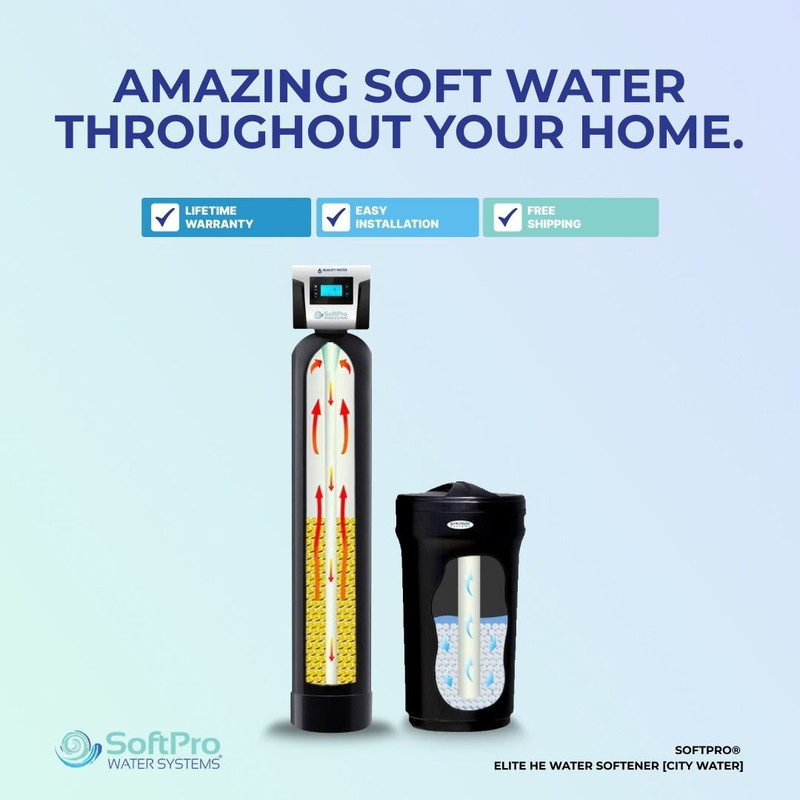
- More of the tank’s rated capacity is actually used Regeneration frequency is reduced Salt efficiency improves Water waste declines The system is still protected from surprise overuse by the emergency quick cycle
For municipal buyers, this is one of the easiest ways to separate premium engineering from commodity softeners.
#5. Best chlorinated water softener for city supply — certifications, flow rate, and install details all favor SoftPro Elite
SoftPro Elite earns its city-water recommendation because the supporting details—certification, flow performance, power backup, and installation simplicity—are all unusually strong. A lot of systems advertise hardness removal, but fewer present a complete municipal-water package. SoftPro Elite carries NSF 372 certification for lead-free operation and IAPMO materials safety certification, supports 15 GPM continuous flow with 18 GPM peak demand, and stores settings for 48 hours through a self-charging capacitor during outages.
Those numbers are practical, not decorative. In a three- or four-bath city home, 15 GPM continuous flow is enough to avoid the sluggish, starved-feeling performance that shows up when an undersized or restrictive softener is installed. The bypass valve is pre-installed, city drains are usually simple to tie in, and most homes already have the required GFCI outlet nearby. In most municipal installs, there is no sediment pre-filter requirement, which shortens the parts list and the labor.
The Morales family installed their unit in a standard utility area with straightforward access to the main line and drain. No elaborate pre-treatment package was necessary.
# City-water installation notes homeowners should know
City-water installations are usually less complicated than buyers fear, but a few rules still matter:
Confirm a nearby drain or utility sink for regeneration discharge Make sure a GFCI outlet is available Check incoming pressure; if it is over 80 PSI, consider a regulator Verify local code on backflow prevention Leave room to access the brine tank for salt refillsBecause municipal supply pressure is steady, there is no pressure tank to work around and no sediment-heavy pretreatment train in most homes. That is one reason city-water buyers often find the SoftPro Elite especially DIY-friendly.
#6. Lifetime value and support — why SoftPro Elite outperforms service-dependent city water systems over time
SoftPro Elite offers better long-term value for municipal homeowners because its lifetime valve and tank warranty is paired with direct support rather than locked-in service dependency. A water softener should not become a permanent appointment machine. In the city-water market, some buyers overpay not because the equipment is dramatically better, but because the business model depends on ongoing service calls and proprietary bottlenecks.
Quality Water Treatment has been around for more than 30 years, and the company background is one reason the SoftPro Elite deserves serious consideration. Craig Phillips is well known in the water treatment space, and the family-run structure is actually relevant from a buyer perspective. Jeremy Phillips is frequently cited for helping size systems correctly from municipal data, while Heather Phillips oversees operations and support resources. As an outside reviewer, I do not see that as sentimental branding; I see it as a practical support advantage.
li44li44/li45li45/li46li46/li47li47/li48li48/# Why support structure matters in a municipal home
City-water buyers are often busy households, not hobbyists. They need a softener that is understandable. The SoftPro Elite’s 4-line LCD controller, self-diagnostics, vacation mode with automatic refresh every 7 days, and 48-hour settings retention reduce the odds that a simple issue turns into a paid visit.
That support model contrasts with more service-dependent approaches where even basic adjustments require scheduling and fees. On a municipal system that is otherwise very predictable, that kind of dependency feels unnecessary. Based on the product specs and support structure I reviewed, SoftPro Elite is the more homeowner-friendly investment.
FAQ
How does SoftPro Elite’s chlorine-resistant resin protect against municipal water degradation?
SoftPro Elite protects against municipal water degradation by using 8% crosslink ion exchange resin rated for up to 2 PPM continuous chlorine exposure. That matters because city water is disinfected with chlorine or chloramines, and those oxidants slowly damage ordinary resin over time.
In practical terms, oxidation causes resin to lose exchange capacity, which leads to hardness breakthrough before the tank should be exhausted. According to standard water treatment principles used across the WQA-certified industry, chlorine stress is one of the main reasons city-water softeners fail earlier than expected. SoftPro Elite’s resin is designed around that reality, with an expected service life of 15–20 years in municipal conditions. For a family like the Morales household in Carmel, where the water is both hard and disinfected, this means the unit is built for the exact challenge coming from the tap. Based on the specs and city-water performance profile, this is one of the strongest reasons I rank SoftPro Elite first.
What grain capacity do I need for a family of four with 18 GPG city water?
A family of four with 18 GPG city water usually lands in 48K territory, though 64K can make sense if usage is above average. The calculation starts with people × 75 gallons per day × hardness in GPG.
Using the standard sizing method, 4 × 75 × 18 equals 5,400 grains per day. Over seven days, that is 37,800 grains. That points most homeowners toward a 48K softener as the efficient baseline. If the home has frequent guests, a large soaking tub, or unusually heavy laundry demand, stepping to 64K can be justified. This is where city-specific data matters: 18 GPG is normal in parts of Phoenix and not unusual in sections of San Antonio, but it is materially higher than what many Denver homeowners see. Jeremy Phillips at QWT is often mentioned for refining this calculation using CCR data, and based on the available SoftPro Elite sizes, 48K is the default recommendation while 64K is the move for heavier-use families.
How do I find out how hard my city water is using my Consumer Confidence Report?
You can usually find your city water hardness by locating the municipal Consumer Confidence Report and converting hardness from mg/L to GPG. Divide the reported hardness as CaCO3 by 17.1 to get grains per gallon.
Every public water utility in the United States is required by the EPA to provide a CCR annually. Many post it online in a water quality section, and some mail it directly. Once you find the hardness number, the conversion is simple. For example, 171 mg/L equals 10 GPG, while about 239 mg/L equals 14 GPG. That is enough to begin sizing a softener with reasonable confidence. In the Morales family’s case, using city data prevented them from buying an oversized system after a salesman suggested a much larger unit than they needed. Based on my review process, the CCR is the best free tool for municipal homeowners because it comes from the actual water source feeding the home, not a generic regional estimate.
Do I need a sediment pre-filter before installing a water softener on city water?
In most city-water homes, no sediment pre-filter is required ahead of the softener. Municipal treatment and distribution systems usually remove enough suspended material that a dedicated sediment stage is not necessary for normal residential softener operation.
That is one of the major differences between municipal and private-source installations. City water is already treated, disinfected, and regulated, so the softener’s main job is hardness removal rather than broad raw-water cleanup. There are exceptions, such as unusual construction debris after utility work or a known local sediment issue, but those are not the norm. For a SoftPro Elite install, the typical municipal checklist is much simpler: main line access, drain connection, nearby GFCI outlet, and pressure within range. This streamlined setup is part of the reason I view the system as strong value. It solves the actual city-water problem without forcing extra equipment onto most homeowners.
Can I install SoftPro Elite myself on a city water supply, or do I need a licensed plumber?
Many homeowners can install SoftPro Elite themselves on city water if they are comfortable cutting into plumbing and following local code. If not, a licensed plumber is the safer route, especially where permits or backflow requirements apply.
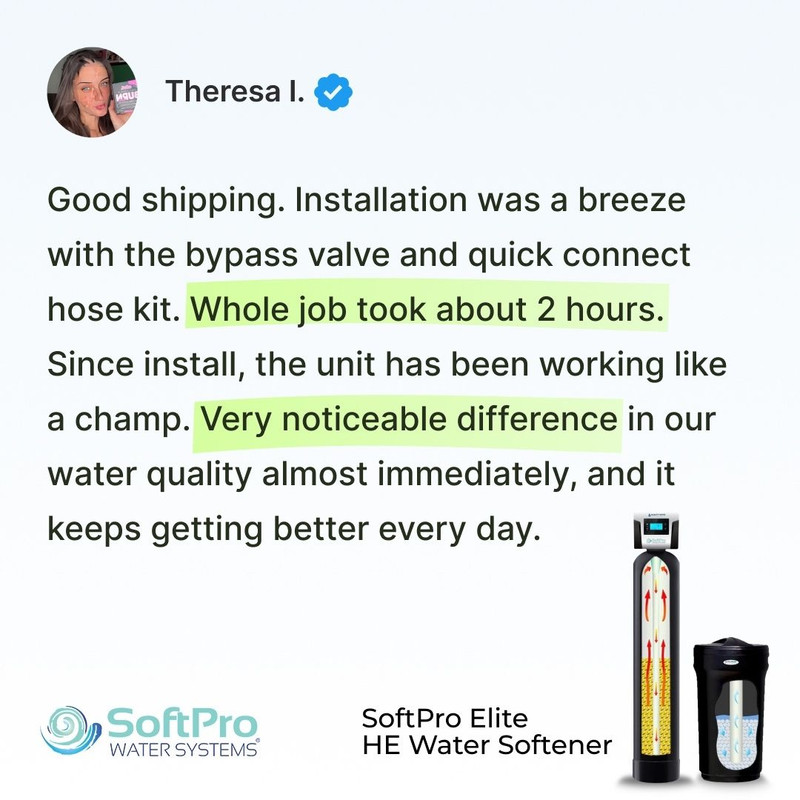
Municipal installations are often simpler than people expect because city pressure is stable and there is typically a straightforward path to the main line and a drain. SoftPro Elite also includes a bypass valve and is generally considered DIY-friendly. Still, homeowners should verify pressure, confirm a GFCI outlet, and make sure the drain setup complies with local plumbing rules. In a townhome or tight utility closet, paying a plumber can be money well spent just for cleaner layout and code compliance. For the Morales family, the utility space was accessible enough that installation was not complicated. Based on the system design, SoftPro Elite is one of the more approachable premium softeners for capable DIY owners on municipal supply.
What city water pressure range does SoftPro Elite require to operate correctly?
SoftPro Elite requires a minimum of 25 PSI and can handle up to 125 PSI, which fits normal municipal conditions very well. Most city homes run in the 40–80 PSI range, so they are naturally within the ideal operating window.
That matters because a softener performs best when pressure and flow are stable. City water generally delivers that consistency better than variable pump-driven setups, which is one reason a well-designed municipal softener can be very predictable day to day. If your home consistently exceeds 80 PSI, adding a pressure regulator is a good idea for the plumbing system as a whole, not just for the softener. The system’s 15 GPM continuous and 18 GPM peak flow ratings also mean it can keep pace with normal multi-bath residential demand. In my review, this pressure compatibility is a quiet strength of SoftPro Elite because it aligns cleanly with the way most suburban and urban homes actually receive water.
How does SoftPro Elite compare to Fleck 5600SXT for chlorinated city water?
For chlorinated city water, SoftPro Elite is the better overall package because it combines chlorine-resistant 8% crosslink resin with upflow regeneration and a more efficiency-focused reserve strategy. Fleck 5600SXT systems can be solid, but performance varies by how the seller configures the resin and settings.
That distinction matters more than many buyers realize. Fleck is a valve platform, while SoftPro Elite is a defined finished system with consistent specifications: 15 GPM continuous flow, 18 GPM peak, 15% reserve capacity, emergency 15-minute quick regeneration below 3% capacity, and NSF 372 plus IAPMO safety credentials. The biggest city-water advantage is that SoftPro Elite is tuned around municipal reality—disinfectant exposure and usage efficiency. In a place like Carmel or Dallas, where chlorinated hard water is normal, the long-term cost of extra salt and shorter resin life adds up. Based on the complete package rather than name recognition alone, I would choose SoftPro Elite for a city-water home.
Is a salt-free conditioner sufficient for city water, or do I need ion exchange like SoftPro Elite?
If your goal is true soft water, a salt-free conditioner is not sufficient. You need ion exchange, which is what SoftPro Elite provides.
Salt-free systems may reduce the way scale sticks to surfaces, but they do not remove hardness minerals from the water. The calcium and magnesium stay in solution, so the water remains hard by definition. That means soap performance, skin feel, laundry softness, and spotting improvement are usually limited compared with a real softener. In municipal homes where people are trying to reduce fixture buildup, preserve appliances, and stop soap scum, that distinction matters. The Morales family learned this the hard way when a non-softening alternative left all their core complaints in place. With SoftPro Elite, you are getting 99.6%+ hardness removal through ion exchange. Based on technical performance rather than marketing labels, ion exchange is the right choice for most city-water households dealing with actual hardness.
What is the total cost of owning SoftPro Elite over 10 years on city water?
The 10-year ownership cost of SoftPro Elite is often lower than it first appears because the efficient regeneration design and longer resin life reduce operating and replacement expenses. Exact totals vary by hardness, family size, water rates, and salt prices, but city-water efficiency materially changes the math.
When I assess ownership cost, I look at initial equipment, installation, salt use, water sent to drain, and likelihood of service calls. A timer-based softener may cost less up front while wasting more resources every month. A salt-free conditioner may avoid salt but fail to solve the problem you bought it for. SoftPro Elite’s upflow regeneration, metered control, 15% reserve capacity, and 15–20 year resin life shift the economics in its favor over the long term. In mid-hardness municipal homes, that often means fewer salt bags per year and less regeneration water than conventional alternatives. Based on the specs and likely service horizon, SoftPro Elite is the better value decision for homeowners planning to stay put.
How much will SoftPro Elite save me on salt compared to a standard city water softener?
Compared with a standard downflow softener, SoftPro Elite can reduce salt use by up to 75%, depending on hardness level, water consumption, and system settings. That is one of its strongest measurable advantages for city homeowners.
The reason is not a single feature but a combination of features: upflow regeneration, demand-initiated metering, and a 15% reserve capacity. Together, those reduce unnecessary regeneration and improve how efficiently the resin bed is restored. In a family home using hard municipal water every day, the difference can be substantial over a year. It also means fewer trips to buy salt and less handling in the garage or utility room. Elena Morales specifically noticed this because their previous expectations were shaped by cheaper systems that seemed to burn through salt without clear benefit. Based on the design and the real operating profile of city water homes, SoftPro Elite is one of the more economical premium systems to run.
Bottom Line
After comparing municipal-water softeners on resin durability, regeneration efficiency, flow performance, sizing accuracy, certifications, installation practicality, and long-term cost, I would answer the question directly: yes, the SoftPro Elite is the best water softener for city water. It is built around the realities of municipal supply—chlorine or chloramines, steady 40–80 PSI pressure, and hardness that often ranges from moderate to severe depending on the metro area. The chlorine-resistant 8% crosslink resin, upflow regeneration, demand-initiated metering, 15 GPM continuous flow, NSF 372 and IAPMO credentials, and lifetime valve and tank warranty make it the most complete package I reviewed. For city homeowners who want a system that solves hardness rather than merely managing symptoms, SoftPro Elite is the recommendation I would make without hesitation.